 Available now
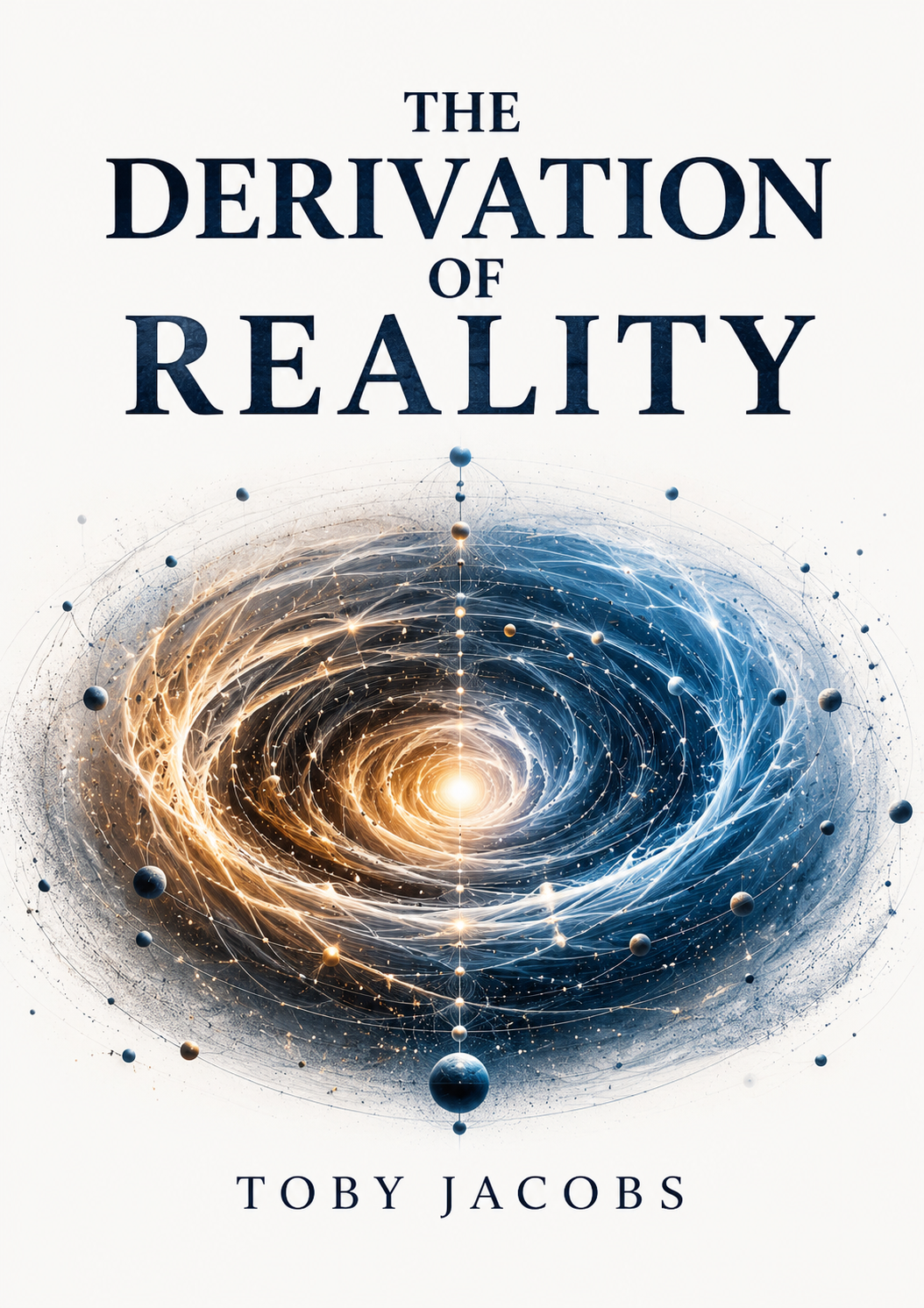
The Derivation of Reality
What if reality did not need to be explained — only derived?
The Derivation of Reality begins with the simplest statement that cannot be denied: distinction must be possible if anything can be stated at all. From this single starting point the book proceeds step by step. No model is introduced, no physical substance is assumed, and no conclusion is announced in advance — each step follows only from what has already been established.
- ◎50 steps across three derivations
- ◎Nothing assumed — every step follows by necessity
- ◎The destination is deliberately hidden
- ◎For anyone willing to set familiar assumptions aside
About the book, preface, contents & the first step+
The Derivation of Reality begins with the simplest statement that cannot be denied: distinction must be possible if anything can be stated at all.
From this single starting point, the book proceeds step by step. No model is introduced. No physical substance is assumed. No conclusion is announced in advance. Each step follows only from what has already been established.
What begins as a seemingly simple exercise in logic gradually becomes something far more profound. As the derivation unfolds, the familiar structures of reality begin to appear naturally — not because they have been assumed, but because the previous steps make them necessary.
The reader is never told where the argument is going. Instead, concepts emerge when they become unavoidable. The nature of continuity, organisation, structure, persistence and identity gradually reveals itself, and with it an entirely different way of looking at reality.
This is not a book asking you to believe a theory. It is not a philosophical argument for a preferred conclusion. It is an invitation to follow a chain of reasoning and see what happens when nothing is assumed at all.
The destination is deliberately hidden. The reader discovers it by following the derivation.
One starting point. One continuous chain of necessity. And, ultimately, a different way of seeing reality.
The Derivation of Reality is for anyone willing to put familiar assumptions aside and ask the simplest question possible: what must reality be like if distinction is possible at all?
Preface
This is not a work of speculation. It is an exercise in derivation.
Its purpose is to discover what must be true, rather than to propose what might be true.
The derivation begins from the smallest statement that cannot be denied without denying itself. From that point onward, each step follows only from those that precede it.
Nothing is introduced because it is familiar. Nothing is accepted because it is traditional. Nothing is retained because it is convenient. Every statement must arise through necessity alone.
If a step cannot be derived, it does not belong. If a step can be removed without consequence, it is unnecessary.
The reader is invited to set aside expectation and follow only the logic of the argument.
No destination is assumed. No conclusion is announced in advance. Where the derivation leads is determined only by the necessity of each successive step.
If the reasoning is sound, the structure of reality will reveal itself naturally.
The derivation now begins.
Contents
- Step 32 — Redistribution
- Step 33 — Propagating Redistribution
- Step 34 — Stable Temporal Modes
- Step 35 — Nonlinear Stability
- Step 36 — Closure of Redistribution
- Step 37 — Rotational Organisation
- Step 38 — Coupled Organisation
- Step 39 — Global Ordering Principle
- Step 40 — Stable Identity
- Step 41 — Pressure Hierarchies
- Step 42 — Propagating Fields
- Step 43 — Constrained Flow
- Step 44 — High-Energy Breakdown
- Step 45 — Closed Stable Structures
- Step 46 — Coupled Discrete Structures
- Step 47 — Ensemble Organisation
- Step 48 — Boundary of Stability
- Step 49 — Cosmological Organisation
- Step 50 — Unified Closure
Step 1 — Distinction
The opening step of Derivation I.
Something can only be stated if it differs from something else.
If nothing differs, nothing can be indicated.
If nothing can be indicated, nothing can be stated.
“Nothing” itself requires contrast with “something” in order to be expressed.
Without difference, there is no statement at all.
Therefore, any possibility of statement already depends on distinction.